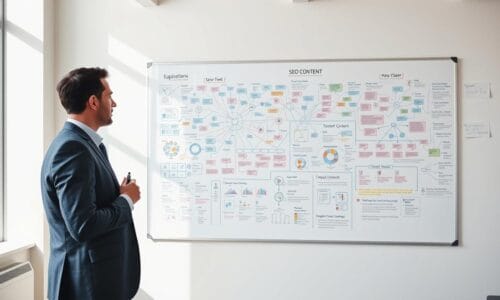
Surprising fact: in 2025, more than 40% of marketers plan their strategy ahead to avoid silos and missed opportunities.
That shift matters because a unified plan turns scattershot efforts into predictable growth. We frame our approach as a clear, step-by-step path that lifts ideas into measurable outcomes.

At Web Solutions For All, we focus beyond rankings. Our work connects SEO and human-first writing so each piece drives qualified traffic, conversions, and revenue.
We explain how a single calendar aligns blog, email, and social channels so your audience sees one consistent narrative across your website and channels. You can also review practical methods and the tool-agnostic workflows we use in our guide on best SEO content strategy practices.
Key Takeaways
- Advanced planning centralizes workflows and reduces wasted effort.
- A unified plan aligns marketing channels for consistent audience experiences.
- We tie every initiative to goals like traffic, conversions, and revenue.
- Tool-agnostic methods scale teams without extra complexity.
- Immediate wins exist (titles, metas) while authority building compounds over time.
Set the Stage: What Optimized Content Planning Looks Like Today

Modern planning blends research, data, and tools so themes, owners, and windows are set without losing agility.
We define “optimized” as a centralized plan that combines editorial priorities, SEO needs, and channel distribution into one trackable system.
That system reduces last-minute scrambles by locking in themes, owners, and publish windows while leaving room for trend-driven inserts.
Our lean process focuses on impact: set KPI targets, map topics to intent and funnel stages, then commit to a cadence your team can sustain.
Shared visibility across channels prevents duplicated work and missed handoffs. This alignment drives clearer attribution and better business results.
- Centralized calendar that blends editorial and distribution.
- Tool-assisted workflows for briefs, approvals, and analytics.
- Data-informed iteration after every sprint.
| Focus | Practical Action | Success Marker |
|---|---|---|
| Editorial + SEO | Map topics by intent and funnel stage | Higher topic authority |
| Workflow | Standardize briefs and approvals in one tool | Reduced cycle time |
| Measurement | Set KPIs and review benchmarks each sprint | Clear attribution to pipeline |
Unlock your business’s full potential with our results-driven SEO strategies—our frameworks drive growth, not just rankings. Let’s grow together. Contact us today!
Research First: Audience, Intent, and Competitive Insights that Guide Your Plan
Good research turns assumptions into clear audience signals that steer every editorial decision.
Define intent before you draft a single piece. We map search intent (informational, navigational, transactional) to TOFU, MOFU, and BOFU so every headline and CTA has a measurable job.
We build target audience personas from CRM notes, interviews, and win/loss data. Those signals turn buyer pain into topics and subtopics that matter.
Competitive analysis reveals what top pages cover and where they fall short. That lets us add original value—case proofs, expert quotes, or proprietary data—rather than repeat what’s already ranking.
- Validate topics with keyword difficulty, volume, and intent.
- Document the “why us” angle for each topic so writers can thread positioning naturally.
- Lock research into the plan with owners, deadlines, and acceptance criteria.
For a practical template, review our marketing plan guide and the research-driven framework we use to translate insights into action.
Centralize Your Process to Eliminate Silos and Improve Team Velocity
Bringing calendar, briefs, and analytics into one view shrinks review cycles and keeps the team focused.
We centralize workflows so your team moves faster and produces more consistent output. An all-in-one calendar aligns blog, email, and social channels. That reduces overlaps and keeps messaging unified across every campaign.
Create a shared content calendar that aligns blog, email, and social
We implement a shared editorial calendar that sets cadence and owners. Stakeholders see deadlines, distribution notes, and UTM conventions in one place.
For a practical template, review our shared editorial calendar that ties production to performance.
Choose collaborative tools to manage ideation, scheduling, and approvals
We pick tools that match your team’s maturity and integrate docs, tasking, asset libraries, and analytics. This reduces copy/paste and context switching.
- Standardize briefs, status tags, and approval checklists to cut cycle time and rework.
- Design governance with roles, SLAs, and routing rules so approvals don’t stall work.
- Connect calendar entries to KPIs so performance is visible at the plan level.
| Focus | Action | Success Metric |
|---|---|---|
| Calendar | Align blog, email, and social cadences | Fewer scheduling conflicts |
| Workflow | Use checklists and status tags | Shorter review cycles |
| Tools | Integrate docs, tasks, and analytics | Less context switching |
| Governance | Set roles and SLAs | Reliable approvals |
We centralize workflows to drive meaningful growth—our team aligns calendars, content, and SEO so you see results faster. Let’s grow together. Contact us today!
Use AI Strategically to Accelerate Planning without Losing Quality
AI should speed smart work while experts keep final control. We use models to draft title variants, scaffold outlines, and pull topic prompts from approved keywords.

In 2025, 56% of agencies use generative systems for ideation and caption drafting. We build a prompt library so output matches brand tone and reduces repetitive edits.
- Automate low-differentiation tasks—title testing and brief drafts—so teams save time and focus on insight.
- Plan repurposing early: one blog post can yield social media threads, short video scripts, and email teasers.
- Set guardrails: reusable prompts, human QA, A/B testing, and tags for any AI-assisted element.
- Integrate AI tools with your stack to push drafts into docs, CMS, and calendars without manual transfers.
- Document limits—medical and legal claims require subject-matter signoff before publish.
We harness AI as an assistant, not a replacement. For a practical take on enterprise adoption, review our note on AI business strategy. This approach preserves quality while improving speed and measurable results.
Distribute Smart: Multi-Channel Publishing That Meets Audiences Where They Are
Smart distribution multiplies reach by adapting a single idea into channel-native posts.
We amplify your best work across platforms by tailoring messages and formats for each audience. Multi-channel automation tools like Buffer and Hootsuite let us schedule and repurpose assets from one dashboard without extra manual steps.
Automate cross-channel scheduling while tailoring messages per platform
We create platform-native variations that respect hooks, length, and visuals for LinkedIn, X, YouTube, email, and the blog.
- Schedule posts from a single dashboard and publish at the optimal days and times per channel for maximum reach.
- Pair short-form video with thought-leadership snippets and carousels to serve mixed consumption habits.
- Attach UTMs to every link and centralize reporting so each post’s performance is traceable.
Post at channel-specific optimal times to maximize reach and engagement
We define the target and objective for each post—awareness, engagement, or conversion—so CTAs and tracking match the goal.
- Apply a remix cadence (3-3-3): three formats, three angles, three channels for efficient reuse.
- Boost proven winners with paid spend and retarget engaged users with mid-funnel offers.
- Align sales enablement by sending reps the week’s best assets and short talk tracks.
Build for Findability and Authority: Technical and On-Page SEO Essentials
Findability starts with pages that guide users and crawlers toward clear signals of expertise and relevance.
On-page basics matter. We craft engaging titles, readable URLs, and meta descriptions that set accurate expectations and win clicks. Headers carry natural keywords and clear hierarchy so readers and search engines understand each page quickly.
Visuals support trust. We add diagrams, data graphics, and videos with descriptive file names and alt text to boost accessibility and image discovery.
Internal linking and topic clusters
We map pillars and support pages into clear clusters. Internal links distribute authority across the website and help search engines index related topics.
UX, speed, and readability
Fast pages, mobile-first layouts, and simple navigation improve the user experience and lift ranking signals. We test load time and reading flow so technical fixes and editorial edits work together.
Refresh and prune
Quarterly refresh cycles add new data or consolidate weak pages. We document broken links, schema opportunities, and on-page tasks so the plan covers both infrastructure and editorial work.
We engineer discoverability into every page—going beyond rankings to build sustainable authority and business impact. Unlock your business’s full potential. Contact us today!
ways to optimize content planning for conversions, not just traffic
Drive measurable pipeline growth by mapping every piece to an intent-driven path. We plan for pipeline, not vanity metrics—each asset should hand prospects forward through TOFU, MOFU, and BOFU.
Map assets to funnel stages and buyer personas
We map each persona’s journey and assign jobs for discovery, nurture, and proof. TOFU attracts, MOFU nurtures, and BOFU closes with social proof and demos.
Craft contextual CTAs: fast, medium, slow
Fast CTAs target BOFU (free trial, demo). Medium CTAs nudge MOFU (guide, checklist). Slow CTAs suit TOFU (newsletter, updates).
Choose formats that convert
We favor case studies, step-by-step guides, short product videos, comparison pages, and webinars. These formats prove value and reduce friction for the next action.
- Personalize offers by industry, role, and pain point.
- Track micro and macro conversions—scrolls, CTA clicks, and form fills.
- Align sales with content so reps follow up with the right asset.
- Test CTA copy and placement and iterate rapidly.
We plan for pipeline, not vanity metrics. For practical tactics on how to increase conversion rate, review conversion-focused testing and flows that lift outcomes and long-term success.
Measure What Matters: Analytics to Refine Topics, Timing, and Channels
Measurement closes the loop between ideas and revenue by showing which topics actually move the needle.
Set KPI targets upfront: engagement, traffic, and conversions
We set clear goals before the first draft. Each campaign has KPI targets for engagement, qualified traffic, and conversions so success is measurable.
Use dashboards to track content performance and internal usage
We implement centralized dashboards that merge web analytics, channel metrics, and internal collateral use.
This single view helps sales and marketing see which assets reps send most and which lift pipeline.
Iterate with insights: double down on winners, rework low performers
We analyze search visibility, CTR, and dwell time to spot messaging or UX fixes.
Weekly reviews highlight winners to amplify and low performers to fix or retire.
- Measure time-to-publish and cycle time to remove bottlenecks.
- Normalize results by channel and format for fair comparison.
- Document learnings and fold them into the next sprint plan.
| Metric | What we track | Action |
|---|---|---|
| Engagement | CTR, dwell time, shares | Adjust headlines and UX |
| Traffic | Qualified sessions, referral sources | Refine distribution and search strategy |
| Conversions | Form fills, demo requests, MQLs | Improve offers and CTAs |
We connect planning and performance—our dashboards tie activity to impact so you can invest with confidence. Unlock your business’s full potential. Contact us today!
Conclusion
A concise playbook that balances UX, SEO, and distribution makes publishing repeatable and effective.
We recap the core playbook: align planning with goals, ground topics in research and intent, and run a process that ships quality every cycle.
Optimization must be holistic—technical fixes, on-page work, UX, and distribution all matter. Use AI and tools as accelerators, not replacements, so your team creates trusted work that serves your audience.
Measure results with dashboards, test headlines and visuals, and prune weak pieces. We’re here to help you turn planning into predictable growth. Unlock your business’s full potential with our results-driven SEO strategy. Let’s grow together. Contact us today!
FAQ
What does an optimized content planning process look like today?
An effective process combines audience research, clear goals, and a centralized workflow. We start with search intent and buyer journeys, build topic clusters, and align formats across blog, email, and social. The result is predictable publishing, faster approvals, and measurable performance toward traffic and conversions.
How do we define search intent and map it to the customer journey?
We classify queries as informational, commercial, or transactional and place them in TOFU, MOFU, or BOFU stages. Then we match content formats and CTAs to each stage so users get the right message at the right time, improving engagement and lead capture.
What data should inform audience personas and topic selection?
Use analytics, keyword research, customer interviews, and CRM data. Look at search queries, on-site behavior, and conversion patterns to create realistic personas and a ranked topic list tied to business goals.
How do we run a competitive analysis that leads to actionable gaps?
Audit competitors’ top pages, keywords, and content formats. Identify undercovered topics, weak user experience, or poorly structured clusters. Use those gaps to differentiate with deeper guides, better multimedia, or faster page speed.
What are best practices for centralizing content work and improving team velocity?
Use a shared calendar and a single project hub like Notion, Asana, or Monday.com for ideas, briefs, and approvals. Define roles, deadlines, and handoffs to reduce bottlenecks and keep publishing predictable.
Which collaborative tools help manage ideation, scheduling, and approvals?
Choose tools that integrate with your CMS and analytics. Popular choices include Google Workspace for briefs, Trello or Asana for tasks, and Figma for creative reviews. Prioritize automation and permissions to speed reviews.
How can AI speed up ideation without lowering quality?
Use AI for title generation, outlines, and draft briefs, then apply human editing and QA. Create reusable prompts and test outputs with A/B experiments so the team maintains voice and factual accuracy while scaling output.
What’s an efficient approach to repurposing a long-form article across channels?
Extract key insights into social threads, short videos, an email sequence, and a downloadable guide. Tailor the message and CTA per channel rather than copying the same text everywhere to boost reach and conversions.
How do we set AI guardrails for consistent quality and compliance?
Define style guides, approved fact sources, and mandatory human reviews. Log prompts and outputs, and run regular audits to catch drift, bias, or factual errors before publication.
How should publishing be adapted for multiple channels?
Automate scheduling but adapt messaging and format per platform. Short, punchy hooks work on social; long-form works on the blog; and video needs captions and thumbnail tests. Optimize timing based on channel analytics.
When is the best time to post on each channel for maximum engagement?
Best times vary by audience. Use historical engagement data and A/B tests to find channel-specific windows. Monitor and adjust quarterly as audience behavior shifts.
What on-page SEO elements have the biggest impact on findability?
Title tags, URLs, meta descriptions, H1/H2 structure, and optimized visuals drive early gains. Combine these with structured data and a clear internal linking plan to help search engines understand and rank your pages.
How do topic clusters and internal linking boost authority?
Group related pages around pillar content and link them logically. This signals topical depth to search engines and helps distribute link equity, improving rankings for competitive queries.
What technical and UX fixes most improve content performance?
Prioritize page speed, mobile responsiveness, clear navigation, and readable layouts. These reduce bounce rates and increase time on page, which supports both search visibility and conversions.
How often should we refresh existing articles versus retiring them?
Refresh high-potential pages quarterly or when data shows traffic decline but continued search interest. Retire or consolidate thin, underperforming pages when they dilute topical authority or cannibalize conversions.
How do we map content to conversion stages effectively?
Assign formats and CTAs by stage: educational blog posts for TOFU, comparison guides and demos for MOFU, and case studies or trials for BOFU. Track which assets move prospects along the funnel.
What CTA types work best for different intent levels?
Fast CTAs (free download, newsletter) suit TOFU. Medium CTAs (webinar signup, demo request) fit MOFU. Slow CTAs (consultation, trial) are for BOFU. Match urgency and value to intent to increase conversions.
Which content formats consistently drive conversions?
Case studies, how-to guides, product demos, webinars, and short videos perform well. Choose formats based on audience preference, channel, and stage of the funnel.
What KPIs should we set before executing a content plan?
Set measurable targets for organic traffic, engagement (time on page, shares), lead volume, and conversion rate. Tie KPIs to revenue or pipeline metrics to show business impact.
How can dashboards improve content decision-making?
Dashboards unify analytics across channels and show trends at a glance. Use them to spot rising topics, underperforming assets, and opportunities for redistribution or updates.
What process helps teams iterate on content based on analytics?
Run regular review cycles: weekly for distribution, monthly for performance, and quarterly for strategy. Use test-and-learn experiments and document outcomes to refine briefs and topics.
Which tools are essential for research, production, and measurement?
Use keyword tools like Ahrefs or SEMrush, analytics with Google Analytics and Looker Studio, CMS workflows like WordPress or Contentful, and collaboration platforms like Notion. Integrate where possible for efficiency.